

It's 3pm at the kopitiam near the office. One teh tarik with your kuih, a kopi peng after lunch, maybe a bubble tea on the drive home. None of it feels like a meal, but the sugar in Malaysian drinks quietly adds up to nearly as much as everything on our plates.
When people talk about cutting sugar, they usually think about kuih, cake and the extra scoop of rice. Drinks get a free pass. Yet the sugar in Malaysian drinks comes from several directions at once: sweetened condensed milk in teh tarik and kopi, rose syrup in sirap bandung, sugar syrup in bubble tea, and the powder already mixed into a 3-in-1 sachet.
This matters because Malaysia already carries a heavy diabetes burden. According to the National Health and Morbidity Survey 2023, about 15.6% of Malaysian adults have diabetes, and more than half of adults are overweight or obese, figures repeated in coverage of the 2025 sugar tax increase.
Below, we look at what the Ministry of Health's own food database says about the sugar in Malaysian drinks, why it reaches your blood so quickly, how it compares with the WHO daily limit, and what the sugar tax has changed.
How much sugar in Malaysian drinks? A cup-by-cup look
The Malaysian Food Composition Database (MyFCD), run by the Institute for Medical Research under the Ministry of Health, has tested a number of local drinks. The table shows its total sugar figures per 100 ml, and what that works out to for a typical serving. We use about 4 g of sugar per teaspoon.
| Drink (as listed in MyFCD) | Total sugars per 100 ml | Per serving | About |
|---|---|---|---|
| Coffee with milk and sugar, from mamak stalls | 10.3 g | ~26 g per 250 ml cup | 6½ tsp |
| Sirap bandung (condensed/evaporated milk with rose cordial) | 8.7 g | ~22 g per 250 ml glass | 5½ tsp |
| Pearl milk tea, normal sugar | 9.6 g | ~24 g per 250 ml (double that for a 500 ml cup) | 6 tsp |
| Fresh orange juice | 7.2 g | ~18 g per 250 ml glass | 4½ tsp |
| Isotonic drink | 6.7 g | ~13 g per 200 ml | 3½ tsp |
| Malted chocolate milk drink | 5.3 g | ~10.5 g per 200 ml | 2½ tsp |
| Soya bean drink, packet, regular added sugar | 5.1 g | ~10 g per 200 ml | 2½ tsp |
Two ingredients explain most of the sugar in Malaysian drinks made at the stall. MyFCD lists sweetened condensed milk at roughly 44 g of sugar per 100 g, which is close to half its weight, or about 5.7 g in a single tablespoon. An instant tea mix is even more concentrated: about 74% sugar, so one 14.5 g sachet carries close to 11 g before you add anything else.
What about teh tarik and Milo ais?
Teh tarik is the classic hidden sugar in Malaysian drinks. MyFCD doesn't list it as its own entry, but the recipe is the same idea as the mamak coffee above: strong tea, condensed milk, and often a spoon of sugar on top. A 2019 report on Malaysia's sugar habit noted that a glass can hold up to three tablespoons of condensed milk. Using the MyFCD figure, that is about 17 g of sugar from the milk alone. Milo ais is similar: the powder already contains sugar, and most stalls pour in condensed milk as well, so expect it to sit closer to the kopi and teh numbers than to a packet malted drink.
Why the sugar in Malaysian drinks hits your blood sugar so fast
A piece of kuih has to be chewed and broken down before its sugar reaches your blood. A drink skips most of that. There is no fibre to slow it, no protein or fat in most sirap or fruit juice to hold it back, and liquid leaves the stomach quickly. The result tends to be a sharper, earlier rise in glucose than you would get from the same amount of sugar eaten as part of a solid snack.
The second problem is timing. We rarely drink a teh tarik on an empty stomach; it comes with roti canai, nasi lemak or a plate of mee goreng. The drink's sugar then stacks on top of the carbs from the meal, so the post-meal peak is higher and lasts longer.
Over years, the sugar in Malaysian drinks shows up in diabetes risk. A review that pooled 17 long-term studies found that each daily serving of a sugar-sweetened drink was linked to an 18% higher chance of developing type 2 diabetes, and about 13% higher even after accounting for body weight. The same review concluded that fruit juice was unlikely to be a healthy swap.
How much sugar in Malaysian drinks is too much? The WHO 50 g and 25 g line
The World Health Organization recommends keeping free sugars below 10% of your daily energy. For an adult eating about 2,000 calories, that is about 50 g, or 12 level teaspoons. It adds that going down to 5% brings extra benefit, which is about 25 g, or 6 teaspoons. When it comes to sugar in Malaysian drinks, "free sugars" covers sugar added by you or the stall, plus the sugar in syrups, honey and fruit juice. The natural sugar in whole fruit and plain milk doesn't count.
Now put that next to a normal day. Two cups of mamak kopi at around 26 g each already make 52 g, past the upper WHO limit before you have touched anything sweet to eat. One 500 ml bubble tea at normal sugar would use up most of it on its own. The stricter 25 g target is mostly used up by a single teh tarik with an extra spoon of sugar.
National data shows how common this is. Findings from the 2024 national nutrition survey, discussed by a UPM nutrition expert in a January 2026 report on sweet drink trends, put the average adult intake at about 9 teaspoons of sugar a day, with close to half coming from drinks. About 59% of adults have more than one serving of a sugar-sweetened drink every day. In other words, the sugar in Malaysian drinks is not a side issue; for many people it is half the problem.
What the tax changed about sugar in Malaysian drinks, and what it missed
Malaysia started taxing sugary drinks in 2019. The excise duty began at 40 sen per litre for ready-to-drink beverages with more than 5 g of sugar per 100 ml (and fruit or vegetable drinks above 12 g per 100 ml). It went up to 50 sen in 2024 and to 90 sen per litre from 1 January 2025. The Health Minister has said the tax was followed by a 9.25% drop in sugary drink consumption, according to the same Malay Mail report linked above.
That is real progress, but it covers only part of the picture. The tax applies to drinks sold in bottles, cans and packets, but much of the sugar in Malaysian drinks never comes with a barcode. The teh tarik, kopi susu, Milo ais and sirap bandung made fresh at your mamak or kopitiam are generally outside the tax, and those are exactly the drinks many Malaysians have every day. Condensed milk and sugar used at the stall carry no extra duty either.
There is also a design quirk. Because the tax is charged per litre and only above the 5 g threshold, many manufacturers simply trimmed their recipes to sit just under it. A drink at 4.8 g per 100 ml pays no sugar tax, yet a 500 ml bottle still holds about 24 g, roughly the whole stricter WHO allowance. Policy researchers have argued that taxing each gram of sugar, and widening the tax to condensed milk, would send a clearer signal. For now, the practical lesson is simple: a lower price or a "healthier" sticker doesn't mean the sugar in Malaysian drinks has gone away.
Checking the sugar in Malaysian drinks on a label in 10 seconds
- Find "sugars" or "jumlah gula" in the per 100 ml column.
- Multiply by the bottle size. A 500 ml bottle is five times the per-100 ml number.
- Divide by 4 to get teaspoons, and compare with the 6 to 12 teaspoon WHO range above.
If you check your own blood sugar, test once two hours after a meal with your usual drink and once after the same meal with plain water. Our guide to preventing blood sugar spikes explains how to read those post-meal numbers.
Still worried about sugar in Malaysian drinks even with good habits?
Many of our customers tell us they have already cut the sugar in Malaysian drinks they order, switching to kurang manis and skipping the afternoon kuih, yet their post-meal readings are still higher than they would like. That's when some add extra support alongside their routine.
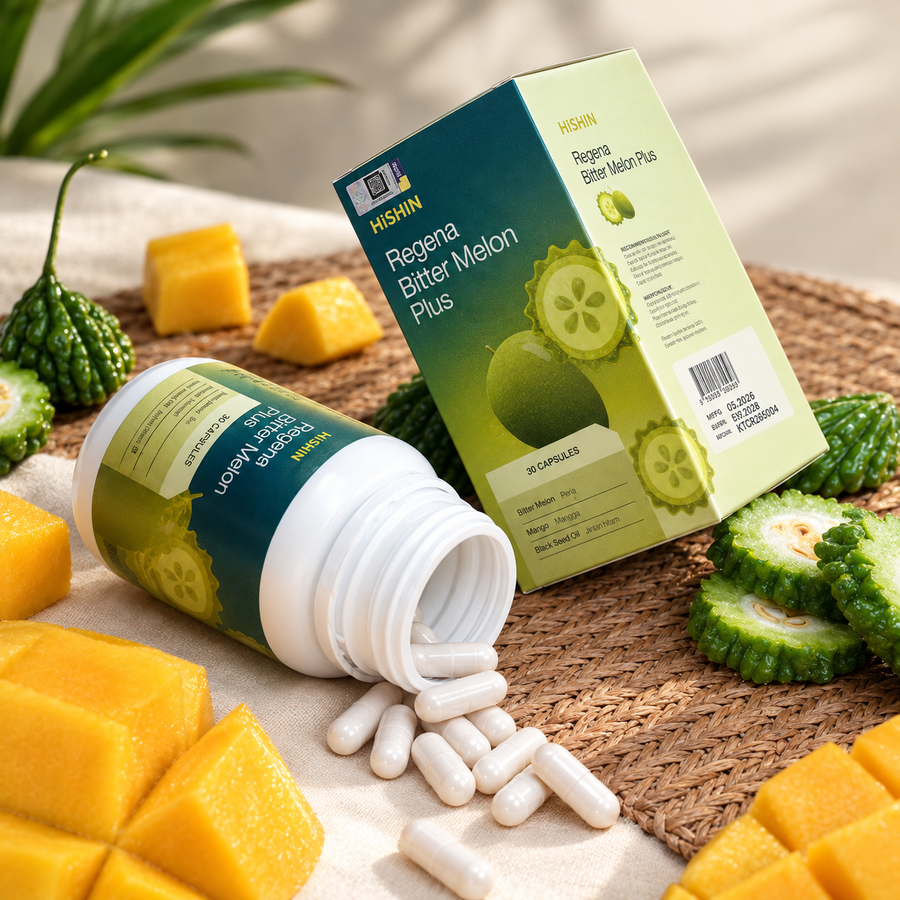
Regena Bitter Melon Plus is Malaysia's only MAL-certified blood sugar capsule, registered with the Ministry of Health (KKM). Each capsule combines three natural ingredients:
- Care300® mango extract — a Swiss patented ingredient with a clinical study published in Planta Medica, supporting insulin sensitivity and helping improve post-meal blood sugar
- Japanese bitter melon peptide — helps slow down sugar absorption
- Antioxidant black seed oil — supports the body's antioxidant defence
Take one capsule after breakfast and one after dinner. The compact bottle slips into your bag, so it goes wherever you makan.
Regena works together with the habits above — not instead of them, and not instead of the treatment your doctor prescribes.
The bottom line
The sugar in Malaysian drinks is easy to miss because it never looks like dessert. A mamak kopi carries around 6 teaspoons, a normal-sugar bubble tea can carry 12, and two or three of these a day take most adults past the WHO limit before food is counted. The sugar tax has nudged packaged drinks, but the fresh drinks we order every day are still in our own hands. Cutting the sugar in Malaysian drinks works best one glass at a time: start with the one you order most often.
Ready to change your order? Our follow-up guide on drinks for diabetes at the mamak, kopitiam and bubble tea shop shows exactly what to ask for, and how to cut the sugar in Malaysian drinks you love step by step.
Sources
- How Malaysia's sugar tax works, from 40 sen in 2019 to 90 sen per litre in 2025 — Malay Mail, 2024
- Sugar content of local drinks: mamak coffee, sirap bandung, pearl milk tea, condensed milk and more — Malaysian Food Composition Database, Institute for Medical Research, Ministry of Health Malaysia
- A glass of teh tarik can hold up to three tablespoons of condensed milk — New Straits Times, 2019
- Review of 17 studies: each daily sugary drink linked to higher type 2 diabetes risk — BMJ, 2015
- Healthy diet: keep free sugars below 10% of energy (about 50 g a day), ideally below 5% — World Health Organization
- 2024 survey findings: close to half of adults' sugar comes from drinks — New Straits Times, 2026
Individual results vary. Regena is a dietary supplement and is not a substitute for medication or medical advice. Please consult your doctor before changing your diet or medication.